
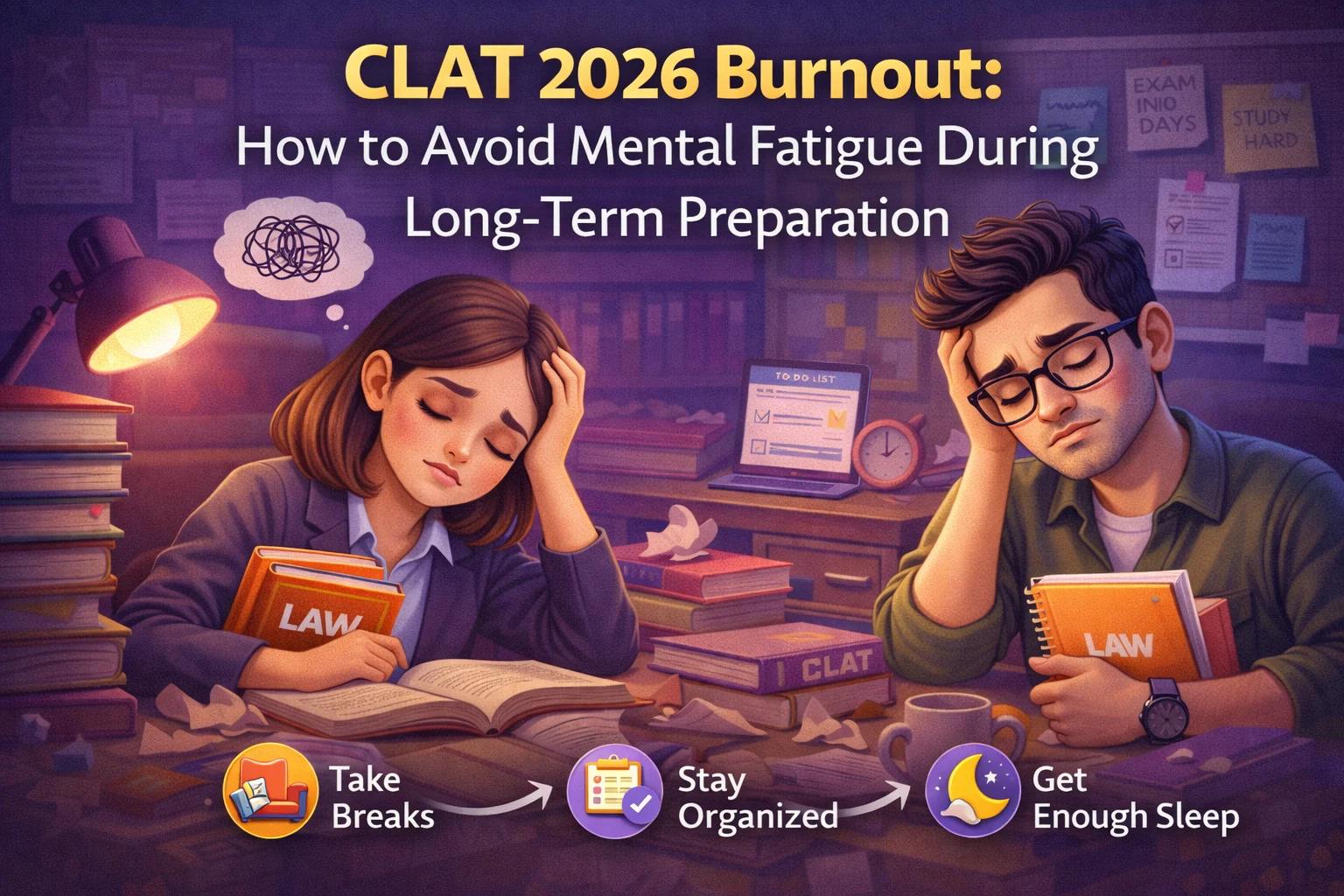
CLAT 2026 Burnout: How to Avoid Mental Fatigue During Long-Term Preparation
June 12, 2026Most CLAT aspirants begin their preparation with real energy. They make study plans, attempt mock tests, and commit to long hours at the desk. But somewhere around the third or fourth month, something quietly shifts. The notes still get made. The pages still get turned. Yet the scores stop improving — and worse, they start dropping.
That shift has a name: burnout.
Burnout is not a sign of weakness or lack of effort. It is what happens when sustained pressure accumulates without sufficient recovery. For CLAT 2026 aspirants in particular, where preparation often stretches across twelve to eighteen months, burnout is one of the most common — and least discussed — reasons behind poor final performance.
This blog breaks down what CLAT burnout actually looks like, why it is becoming more widespread, and how you can take specific, practical steps to protect your mental stamina throughout your preparation.
What CLAT Burnout Actually Looks Like
One of the reasons burnout goes unaddressed for so long is that it does not always look like exhaustion. Most students who are burning out do not stop studying. They keep going — but they start noticing the following:
-
They study for hours but cannot recall what they read the next morning
-
Their mock test scores plateau or decline despite putting in more effort
-
Revision starts to feel pointless, as though the concepts are not sticking
-
They feel a persistent low-level irritability or a sense of dread before sitting down to study
-
Self-doubt creeps in, especially after comparing their performance with peers
None of these are signs of poor intelligence or lack of potential. They are signs that the mind has been stretched without being allowed to rest and rebuild.
What makes this particularly risky for CLAT preparation is that the exam itself demands sharpness — in Legal Reasoning, in Logical Reasoning, in Reading Comprehension. These are not subjects you can attempt on autopilot. A fatigued mind makes careless errors in passages it would otherwise understand clearly.
Why Burnout Is Rising Among CLAT 2026 Aspirants
Understanding the causes is the first step toward addressing them. Burnout during CLAT preparation usually traces back to a few specific patterns.
Unrealistic Study Schedules
Many aspirants copy schedules from toppers or online templates without considering their own starting point, energy levels, or school workload. A fourteen-hour study plan may look productive on paper and be genuinely unsustainable in practice. When the schedule inevitably breaks down, the response is often guilt, which adds psychological pressure on top of physical fatigue.
The problem is not hard work. The problem is a plan that leaves no margin for rest, review, or the natural ups and downs of long-term learning.
Mock Tests Without Proper Analysis
Mock tests are one of the most valuable tools in CLAT preparation — but only when they are used correctly. Many students attempt five to six mocks a week without taking the time to understand their errors. This creates a cycle of repeated mistakes and diminishing returns, where the student feels they are doing a lot but not actually improving.
The goal of a mock test is not to complete it. It is to learn from it. One thoroughly analyzed mock is worth more than five hastily attempted ones.
Constant Comparison and Social Pressure
Group chats, rank announcements, and peer competition are a constant presence in CLAT preparation circles. For some students, this creates healthy motivation. For many others — particularly those who are genuinely working hard but progressing at their own pace — it creates chronic anxiety.
When performance becomes about comparison rather than personal growth, the psychological pressure intensifies in ways that directly accelerate burnout.
Ignoring Physical and Mental Recovery
Sleep, breaks, and light physical activity are not rewards you earn after studying. They are non-negotiable inputs into your ability to study effectively. Students who cut sleep to add more hours of desk time often find that those extra hours produce very little learning and a great deal of fatigue.
The brain consolidates memory during sleep. Skipping it does not save preparation time — it erases it.
How Burnout Damages CLAT Performance
Burnout does not lower your intelligence. But it significantly undermines the mental faculties that CLAT tests most.
Legal Reasoning requires careful reading and judgment — the ability to identify the principle, apply it accurately, and not be misled by attractive wrong options. A fatigued mind rushes this process and makes avoidable errors.
Logical Reasoning asks you to evaluate arguments, spot assumptions, and conclude. This demands sustained concentration. When you are mentally depleted, even familiar argument types start to feel confusing.
Reading Comprehension in English depends entirely on focused attention. Burnout is precisely the condition where attention drifts mid-paragraph, and passages have to be re-read two and three times — costing time you cannot spare in the actual exam.
The cruelest aspect of burnout is that it strikes hardest in the final weeks of preparation, right when the pressure is greatest, and the margin for error is smallest.
Practical Steps to Avoid Burnout During CLAT 2026 Preparation
The good news is that burnout is largely preventable. Not through willpower, but through structure.
Build a Sustainable Study Plan from the Start
A preparation schedule that you can follow consistently for twelve months is worth far more than an aggressive schedule that collapses in week three. Build in daily breaks, one lighter day per week, and monthly review periods. Plan for the long term from the very beginning.
Sustainable does not mean easy. It means realistic. And realistic plans get completed.
Prioritize Mock Quality Over Mock Quantity
Decide in advance how many mocks you will attempt each week — and commit to analyzing every single one. After each test, go through every incorrect answer and understand why you made the error. Was it a concept gap, a reading error, a time management issue, or overconfidence? This kind of reflection produces the actual improvement that mock tests are meant to deliver.
Actively Manage Peer Comparison
It is fine to be aware of where others are in their preparation. It is not fine to let that awareness define how you feel about your own progress. Track your own improvement over time. Compare your score from last month's mock to this month's — not your score to someone else's.
Progress is individual. So is the timeline.
Protect Your Sleep and Recovery Time
Eight hours of sleep is not a luxury for CLAT aspirants. It is a preparation tool. Build it into your schedule as a fixed commitment, not something you give up when you feel behind. Similarly, short breaks during study sessions — ten to fifteen minutes every ninety minutes — actually improve retention compared to extended unbroken sessions.
Balance School and CLAT Preparation Realistically
Students in Class 11 or 12 preparing for CLAT 2026 face a specific challenge: managing school demands alongside entrance exam preparation. The key is integration, not separation. Use your school learning where it overlaps with CLAT subjects, and plan your heavier CLAT sessions during weekends and holidays when school pressure eases.
Keep Career Clarity in View
One surprisingly effective way to reduce burnout is to stay connected to the reason you are preparing. Remind yourself — concretely and regularly — what getting into a National Law University would mean for you. Visit NLU websites. Read about the careers that law school opens up. Career clarity restores motivation when the preparation routine starts to feel mechanical.
How the Right Coaching Environment Reduces Burnout
Burnout does not happen in a vacuum. The preparation environment plays a significant role in either accelerating or preventing it.
When students prepare in isolation — without feedback, without community, without structured pacing — they are far more likely to develop burnout. Self-doubt accumulates when there is no one to tell you that your progress is normal, that the errors you are making are fixable, and that the pace you are moving at is sufficient.
Structured coaching changes this dynamic. When you are part of a small batch with a mentor who knows your performance history, who can identify when you are struggling and adjust the approach accordingly, the psychological load lightens considerably. Regular doubt-clearing sessions mean that confusion does not compound into discouragement. Mock test analysis becomes a conversation, not a private reckoning with a score sheet.
Students seeking CLAT Coaching in Delhi will find that BST Competitive Law's approach is built around exactly this kind of structured, mentored preparation — where the focus is not just on covering content but on sustaining the student's confidence and clarity throughout the journey.
For aspirants in South Delhi, CLAT Coaching in South Ex at BST provides the same personalised batch environment with experienced faculty who understand how to support long-haul preparation.
Students in North Delhi looking for CLAT Coaching in GTB Nagar benefit from BST's small batch model — where individual attention is not an occasional bonus but the standard, making it far easier to flag fatigue before it becomes a crisis.
At the CLAT Coaching in Mukherjee Nagar centre, BST's faculty bring the same commitment to sustainable preparation, regular mentorship, and structured test analysis that prevents the kind of slow accumulation of pressure that leads to mid-preparation burnout.
Why Delhi Continues to Attract Serious CLAT Aspirants
Delhi's position as India's hub for law entrance preparation is not accidental. The city's concentration of experienced faculty, competitive peer communities, and institutions with long track records creates a preparation ecosystem that is genuinely difficult to replicate elsewhere.
For students based in Delhi who are weighing their options, those searching for CLAT Coaching in Delhi Near Me will find that the right institute matters as much as the right student. The structure, the teaching quality, and the mentorship philosophy of the coaching centre you choose will directly shape how you experience the long preparation cycle — and whether you arrive at exam day sharp and ready or worn down and depleted.
Families and students researching CLAT Exam Coaching in Delhi should evaluate institutes not just on their success rates but on their approach to student well-being, batch sizes, and how their faculty responds when a student is visibly struggling.
Students comparing the Top CLAT Coaching Institutes in Delhi will notice that BST Competitive Law consistently stands apart for its small batches, personalized tutoring, and the kind of mentorship support that directly reduces the psychological pressure that leads to burnout.
Managing the Final Phase Without Burning Out
The final six to eight weeks before CLAT are when burnout is most dangerous — and, unfortunately, most common. Students panic, increase their mock frequency, cut down on sleep, and try to revise everything at once. The result is a preparation style that produces anxiety rather than confidence.
The antidote is a clear plan for the final phase. Know in advance what you will revise and when. Maintain your mock test schedule without increasing it. Prioritize accuracy over speed. Trust the preparation you have already done.
Aspirants who have followed a structured year-long plan arrive at the final weeks with a clear sense of where they stand and what they need to do. This clarity is itself a powerful protection against the panic that fuels final-phase burnout.
Conclusion
Burnout is not inevitable during CLAT preparation. It is a product of specific patterns — unrealistic schedules, poor recovery, excessive comparison, and the absence of meaningful mentorship. Identify those patterns in your own preparation early, address them with structural changes, and protect your mental stamina as deliberately as you protect your study hours.
CLAT 2026 is not just a test of how much you know. It is a test of how clearly you think under pressure — and that clarity depends entirely on showing up to the exam mentally intact, focused, and confident. Everything else is preparation for that moment.
FAQs
Q1. Is burnout common among CLAT aspirants?
Ans. Yes, it is one of the most widespread and least discussed challenges in long-term CLAT preparation. The combination of academic pressure, high stakes, and extended preparation timelines makes burnout a genuine risk for most serious aspirants.
Q2. Can burnout affect my CLAT score even if I am studying consistently?
Ans. Absolutely. Burnout specifically impairs the kind of careful, focused reasoning that CLAT tests. Students who are experiencing burnout often make more errors on sections they have already mastered, because their cognitive precision has been worn down by sustained fatigue.
Q3. What are the earliest signs of burnout I should watch for?
Ans. Watch for declining mock scores despite consistent effort, difficulty retaining content you have already studied, reduced motivation in the morning, and a growing sense that more study hours are not producing more improvement. These are early signals, not character flaws.
Q4. How much sleep should a CLAT aspirant get?
Ans. Seven to eight hours of uninterrupted sleep is the baseline for effective learning and memory consolidation. Students who regularly sleep less than six hours will experience measurable declines in reasoning accuracy — exactly the skill set CLAT examines.
Q5. Can the right coaching institute actually reduce burnout?
Ans. Yes, significantly. Small batch sizes, regular mentorship, structured doubt-clearing sessions, and faculty who track individual student progress all reduce the isolation and mounting confusion that are the most common triggers of preparation burnout.