
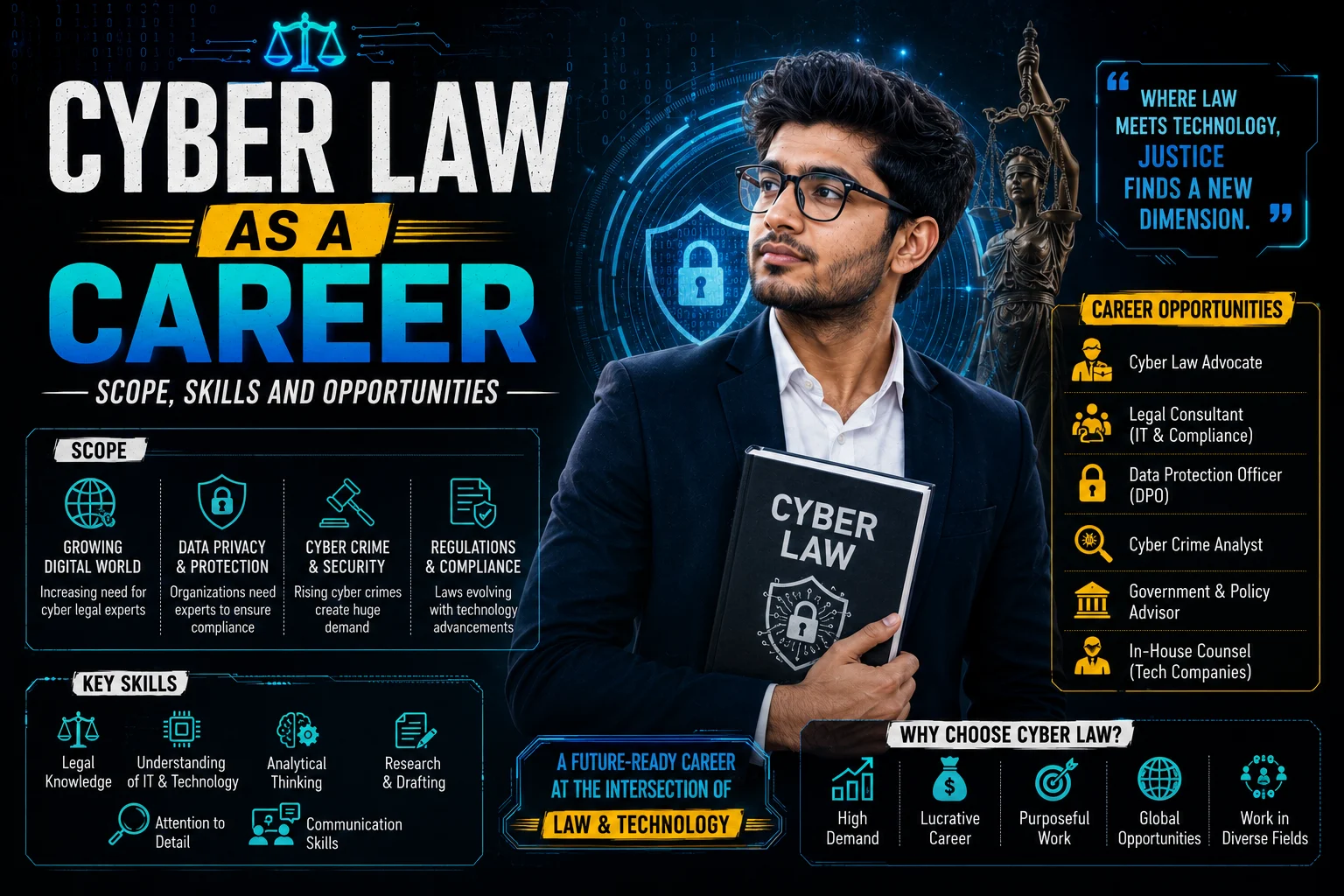
Cyber Law as a Career: Scope, Skills and Opportunities
June 15, 2026The digital revolution has changed the way the world works. Even the simplest tasks like online payments or global businesses running on the cloud now rely heavily on data. Unfortunately, explosive growth has a dark side - a huge wave of data breaches, identity theft, and corporate hacking.
Since traditional laws are unable to deal with crimes committed on the internet, a new legal field has come to prominence as a result. It is not just that a career in cyber law remains an alternative option anymore. In fact, in 2026, it will be one of the most sought-after, future-proof paths in the legal industry. Let's see what this domain has in store and how to get started.
What is Cyber Law?
Essentially, technology law is the set of laws governing the internet, software and electronic devices. It specifies the conduct online and safeguards users from digital harm. Every time data is stolen, a website is hacked or an e-commerce site suffers from fraud, this branch of law comes to the rescue and ensures justice and security.
Getting Into Top Law Colleges
If they want to break into this very advanced legal field, people have to have really top schools in their backgrounds. The best law firms and big tech companies only hire people who went to the top national universities. Doing very well on the really difficult entrance tests requires getting the right kind of help from the beginning.
-
Aiming for the Top: There are thousands of aspirants who shape their basic skills by getting a good CLAT Exam Coaching In Delhi so that they can score high and get into the best National Law Universities.
-
Solid Preparation: Joining a trusted CLAT Coaching In Delhi school not only boosts your reading speed but also helps you develop analytic skills at a very early stage.
-
Other Opportunities: At the same time, a lot of students are interested in finding focused AILET Coaching In Delhi so that they can pass the special entry procedure of the National Law University, Delhi.
-
Smart Practice: Working out many times with the help of a special CLAT Preparation Coaching In Delhi center enables you to think effectively and quickly even when you are doing the most difficult logic sections.
The Rising Scope of the Profession
The employment opportunities for a cyber lawyer with niche skills are increasing at a rapid speed. Implementation changes such as India’s vigorous enforcement of the Digital Personal Data Protection (DPDP) Act have made the issue of legal compliance a must for businesses. Today, every company that processes user data is under the strong regulatory pressure to protect their web portals.
Key Career Opportunities
Those who study this subject thoroughly can discover rewarding jobs in various fields:
-
Corporate and In-House Counsel
Constant legal support is required by technology companies, banks, and fintech firms. Such businesses get experts to prepare the strongest software agreements possible, regulate data privacy policies, and administer risks coming from vendors, among others.
-
Specialized Law Firms
Highly-ranked law firms have established separate digital risk divisions. Such units assist clients in handling cases of significant online fraud, infringement of intellectual property rights, or disputes arising from digital use on an international scale.
-
Government and Law Enforcement
The government sector, police divisions, and specialized cybersecurity cells are among those who have legal advisers on their teams. Aside from helping to identify hackers, these legal personnel also contribute to the examination of digital evidence and the formulation of national internet safety policies.
Essential Skills Required for Success
If you want to succeed in this area, you have to be a mix of a lawyer and a tech person:
-
Tech savvy: Knowing how cloud systems work, data encryption, and network baselines is very important even if you do not code.
-
Good at drafting: Producing accurate, mistake-free privacy policies and technology service contracts is among the everyday requirements.
-
Brainpower: Technology moves way faster than law books. In order to decide on digital issues like AI tools and blockchain assets, law professionals must first find ways to apply the rules developed for the legal system.
Industry Overview: Traditional vs. Tech Law
|
Feature |
Traditional Civil/Criminal Law |
Tech and Cyber Law |
|
Market Growth |
Steady and predictable. |
Rapidly expanding domain. |
|
Primary Employers |
Local courts, individual clients. |
MNCs, tech giants, top law firms. |
|
Geographic Bounds |
Restricted to local jurisdictions. |
Handles cross-border digital actions. |
|
Main Focus Area |
Physical property, local disputes. |
Data privacy, networks, cybercrimes. |
Conclusion: Step Into the Future
Selecting this career path is a wise choice for your law profession. As more and more areas of life become automated, the demand for data protection will be increasing.
If you initiate your exam preparation early, develop the right technical skills, and continue upgrading your knowledge, you can become an essential component of the digital economy. Besides that, staying updated with the latest tech trends will help you land a highest paying legal area.
Frequently Asked Questions
Q.1 Can I become a digital legal expert without a tech degree?
Ans. Certainly. Any graduate who has completed a standard LLB or LLM degree can focus on this area by way of special diplomas and certifications.
Q.2 What is the impact of AI on this career path?
Ans. Artificial Intelligence is leading to legal issues related to data ownership and privacy. This is, in fact, increasing the worldwide demand for specialized legal advisers.
Q.3 Do cyber law experts work in courts daily?
Ans. Not at all. Many experts focus entirely on corporate work, handling issues like compliance, contracts, and digital risk management.